
Rescission of Contract
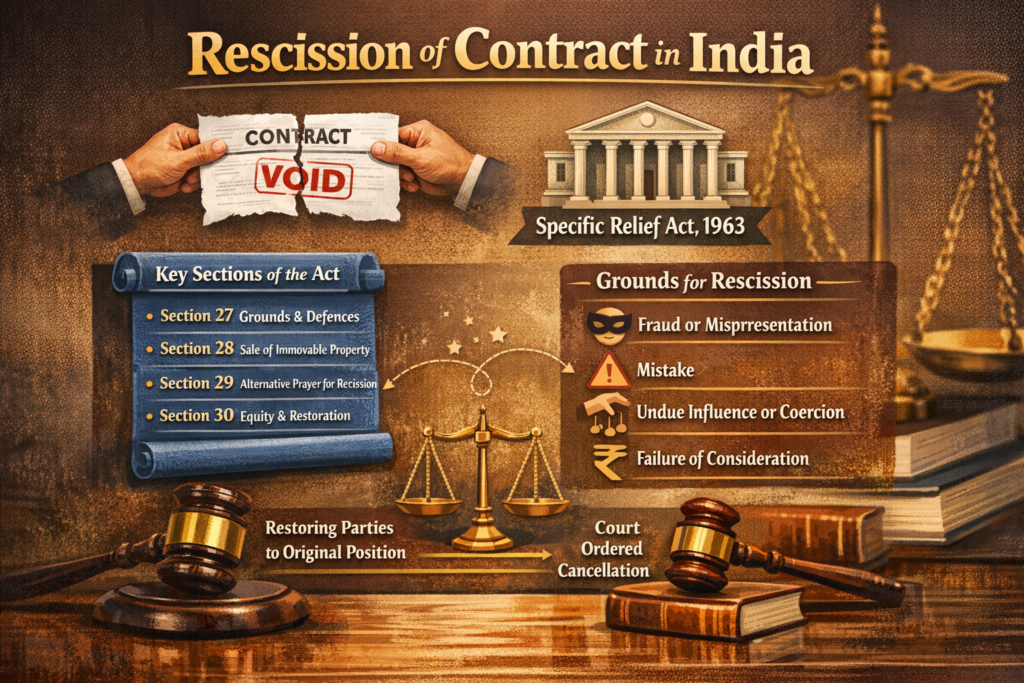
Contracts are the foundation of legal relationships in various aspects of life, whether personal or business. However, there are situations where a contract may need to be invalidated due to unforeseen circumstances, misrepresentation, fraud, or other factors that render the agreement unenforceable. This is where the doctrine of rescission comes into play, offering a remedy for parties who wish to undo the legal obligations created by the contract.
In India, the provisions for the rescission of contracts are governed by the Specific Relief Act, 1963. , the legal grounds for rescinding contracts, and the specific provisions under the Specific Relief Act, 1963 that deal with this remedy.
Rescission
Rescission nullifies a contract, releasing parties from obligations when deemed non-binding by a court. Often pursued due to errors, fraud, or incapacity, rescission strives to restore parties to their original state before the contract. Understand when judicial rescission is applicable, particularly in consumer contracts or insurance policies.
The term “rescission” is derived from the Latin word “rescinder,” which means to cut off or cancel. In the context of contracts, rescission refers to the process by which a contract is cancelled or terminated, returning the parties to the position they were in before the contract was made. It is a remedy that voids the contract, releasing the parties from their contractual obligations.
Rescission is typically sought when a contract has been formed based on misrepresentation, fraud, mistake, or undue influence. The effect of rescission is to restore the parties to their original position, as though the contract had never been made. It can be initiated either by the parties involved (mutual consent) or by a court of law, depending on the circumstances.
Legal Provision in India
Rescission of contract is mainly governed by the Indian Contract Act, 1872.
Important sections include:
Section 19 – Voidability of agreements without free consent
Section 19A – Agreements caused by undue influence
Section 39 – Effect of refusal to perform promise
Section 64 – Consequences of rescission of voidable contract
Section 65 – Obligation of person who has received advantage under void agreement
Provisions for Rescission under the Specific Relief Act, 1963
The Specific Relief Act, 1963, primarily deals with the specific performance of contracts, injunctions, and other related remedies. The Act outlines the specific conditions and legal grounds under which a contract may be rescinded. Sections 27 to 30 of the Act provide the framework for rescission of contracts in India.
Section 27: Where Rescission May Be Adjudged or Refused
Section 27 of the Specific Relief Act, 1963, lays down the circumstances under which a court may adjudicate rescission or refuse to grant it. This section offers both the grounds for rescission and the defences that can be raised against it.
Grounds for Rescission
Voidable Contracts: Rescission can be granted where the contract is voidable or terminable by the plaintiff. For example, if the contract was entered into based on fraudulent misrepresentation, the aggrieved party has the right to have the contract rescinded.
Unlawful Contracts: If the contract is unlawful for reasons not immediately apparent and the defendant is more at fault than the plaintiff, the court may order rescission.
When Rescission May Be Refused
- Ratification: If the plaintiff has ratified the contract, either explicitly or implicitly, the court may refuse rescission.
- Change of Circumstances: If circumstances have changed significantly since the formation of the contract and the parties cannot be restored to their original position, rescission may be refused.
- Third-Party Rights: If a third party has acquired rights in the contract in good faith and without knowledge of the rescission, the court may protect those rights and refuse rescission.
- Indivisibility of the Contract: If only a part of the contract is sought to be rescinded, and that part is inseparable from the rest, rescission may be refused.
Section 28: Rescission in Certain Circumstances of Contracts for Sale or Lease of Immovable Property
Section 28 specifically addresses contracts related to the sale or lease of immovable property. It lays out the conditions under which a decree for the specific performance of a contract can be rescinded. This section is important in real estate transactions, where buyers or lessees may fail to comply with the terms of the decree.
- Grounds for Rescission: If a purchaser or lessee fails to pay the purchase price or any other sum within the time allowed by the decree, the vendor or lessor can apply for rescission of the contract. The court can then rescind the contract, either entirely or partially, depending on the justice of the case.
- Consequences of Rescission: If the contract is rescinded, the purchaser or lessee must restore possession of the property to the vendor or lessor. The court may also order the lessee to pay any accrued rents or profits from the property during the period of possession.
- Further Relief: If the purchaser or lessee pays the required sum within the time allowed, the court may award further relief, such as execution of the proper conveyance or lease.
- No Separate Suit: Section 28 prohibits any separate suit for relief related to rescission. All relief must be sought within the same suit where the decree for specific performance was made.
Section 29: Alternative Prayer for Rescission in Suit for Specific Performance
Section 29 provides that in a suit for specific performance, a plaintiff can alternatively pray for rescission of the contract. This allows flexibility in cases where the court may refuse specific performance but still grant rescission.
- Dual Relief: The plaintiff may ask the court to enforce the contract, and if it cannot be enforced, to rescind it.
- Case Law: Roopchand Chaudhari v. Ranjit Kumar: A plaintiff suing for specific performance may also sue for rescission of the contract. However, a plaintiff suing for rescission cannot ask for specific performance as an alternative.
Section 30: Court May Require Parties Rescinding to Do Equity
Section 30 emphasises the principle of equity in rescission. The court, while adjudicating rescission, may require the party seeking rescission to restore any benefit received from the other party and to compensate for any loss.
- Restoration of Benefits: The court may order the rescinding party to return any benefits received under the contract or to make compensation as justice requires.
- Equitable Doctrine: This section upholds the maxim, “he who seeks equity must do equity.” It ensures that rescission is granted in a fair and balanced manner, without causing undue harm to the other party.
Grounds for Rescission of Contract
- Fraud or Misrepresentation: If one party has been induced to enter into the contract through fraudulent means or false representation, they have the right to rescind the contract.
- Mistake: A mutual mistake regarding the terms or subject matter of the contract can provide grounds for rescission.
- Undue Influence or Coercion: If one party is forced into a contract under pressure, threats, or undue influence, the contract can be rescinded.
- Failure of Consideration: If the consideration for the contract fails, the party who suffers the loss can seek rescission.
– By Shruti Goyal
Advocate in Jaipur
