
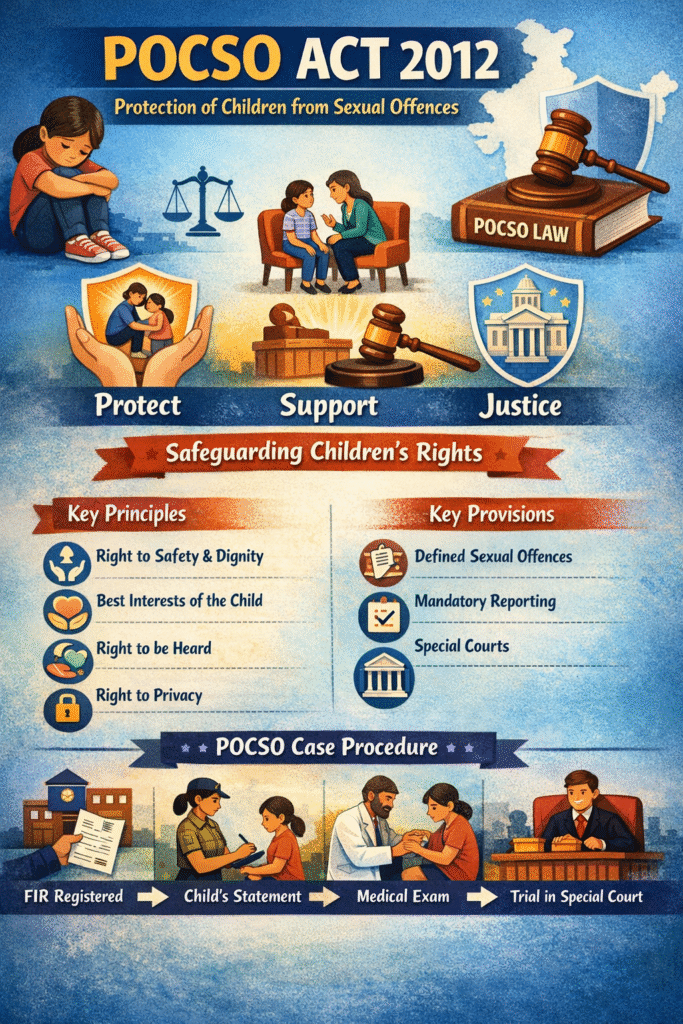
POCSO is the acronym for ‘Protection of Children against Sexual Offences Act’ of 2012. With its enactment, India now has one of the most comprehensive and ambitious laws that not only allows justice for children who are victims of sexual offences but also takes into account the best interests and well-being of the child.In 2012, a landmark reform started with the introduction of the Protection of Children from Sexual Offences (POCSO) Act. The Act aims to protect children by protecting them from sexual assault, sexual harassment, sexual abuse, and child pornography and ensure children are safe and their dignity is upheld. The Act establishes statutory punishments for offenders, as well as a statutory obligation to take reasonable steps to reduce the likelihood of violations of children. The Act creates obligations for employers, educational institutions, and other organisations working with children to provide a safe environment, sensitise staff to abuse prevention and behaviour management, create grievance committees, and develop communication protocols for reporting abuse.
POCSO Act – General Principles
The Protection of Children from Sexual Offences Act, 2012 (POCSO Act ) key principles which are to be followed by anyone, including the State Governments, the Child Welfare Committee, the Police, the Special Courts, NGOs or any other professional present during the trial and assisting the child during the trial. These include:
- Right to life and survival – A child must be shielded from any kind of physical, psychological, mental and emotional abuse and neglect
- Best interests of the child – The primary consideration must be the harmonious development of the child
- Right to be treated with dignity and compassion – Child victims should be treated in a caring and sensitive manner throughout the justice process
- Right to be protected from discrimination – The justice process must be transparent and just; irrespective of the child’s cultural, religious, linguistic or social orientation
- Right to special preventive measures – It suggests, that victimised children are more likely to get abused again, thus, preventive measures and training must be given to them for self-protection
- Right to be informed – The child victim or witness must be well informed of the legal proceedings
- Right to be heard and to express views and concerns – Every child has the right to be heard in respect of matters affecting him/her
- Right to effective assistance – financial, legal, counselling, health, social and educational services, physical and psychological recovery services and other services necessary for the child‟s healing must be provided
- Right to Privacy – The child‟s privacy and identity must be protected at all stages of the pre-trial and trial process
- Right to be protected from hardship during the justice process – Secondary victimisation or hardships for a child during the justice procedure must be minimised
- Right to safety – A child victim must be protected before, during and after the justice process
- Right to compensation – The child victim may be awarded compensation for his/her relief and rehabilitation
What Are the Key Legal Provisions under the POCSO Act?
1. Offences Defined in the Act
In order to facilitate effective enforcement of the Act, the POCSO Act very clearly defines and categorises each sexual offence – penetrative sexual assault, non-penetrative sexual assault, sexual harassment, and the use of a child for pornographic purpose. By clearly defining the terms of offences, the POCSO Act has created legal clarity for enforcement and prosecution purposes.
2. Mandatory Reporting
The Act cascades responsibility for reporting cases of abuse of children by requiring that any person, including teachers, parents, staff or other professionals whose work ordinarily brings them into contact with children who knows of or suspects child sexual abuse is legally obliged to report to the authorities. A person who fails to comply will be subject to legal penalties, which reinforces the responsibility of the community to protect children.
3. Designated Courts and Legal Process
The Act provides for designated courts to facilitate early and sensitive trials. The special courts will host hearings in a child-friendly manner by implementing in-camera courts and recorded testimonies in order to minimise trauma and maintain dignity.
Procedure in a POCSO Case
FIR is registered.
Statement of child.
Medical examination (with consent of guardian).
Charge sheet filed.
Trial before Special POCSO Court.
Advocate in Jaipur
