
Non Supply of Written Grounds of Arrest Does Not Automatically Entitle an Accused to Bail - Rajasthan High Court
In a significant judgment concerning the constitutional safeguards available to arrested persons, the Rajasthan High Court has held that the mere non-supply of written grounds of arrest does not automatically entitle an accused to bail. The Court clarified that while communication of the grounds of arrest is a constitutional mandate flowing from Article 22(1) of the Constitution of India, every procedural irregularity cannot, by itself, render the arrest illegal or become a ground for granting bail. The judgment provides important clarity on the interpretation of recent Supreme Court decisions and the manner in which courts should examine allegations regarding defective arrest procedures.
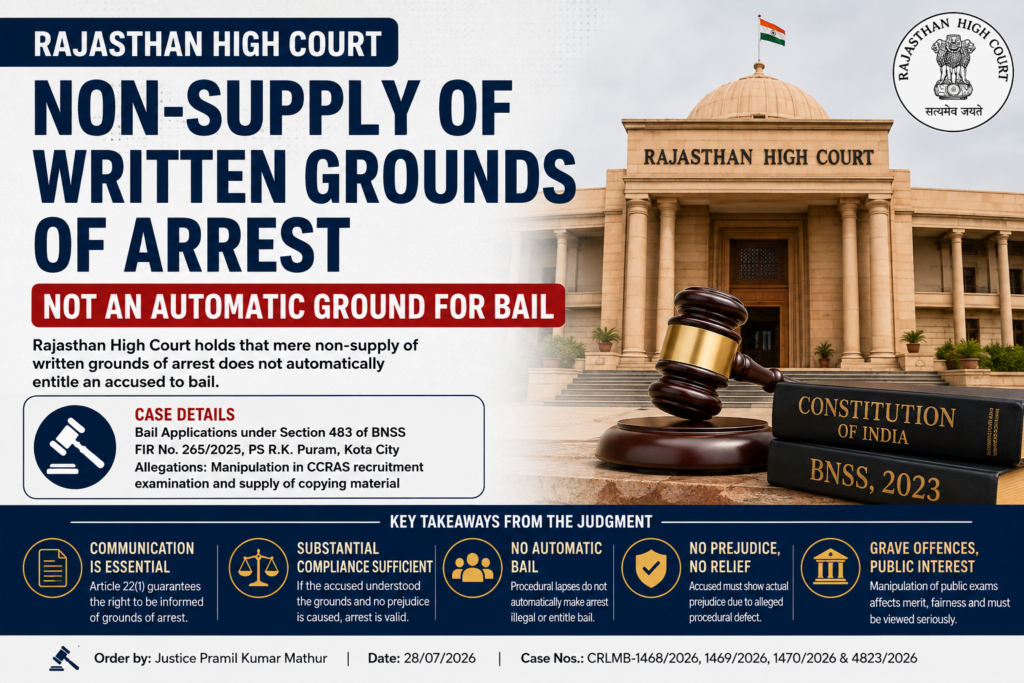
The matter arose from four connected bail applications filed before the Rajasthan High Court under Section 483 of the Bharatiya Nagarik Suraksha Sanhita, 2023 (BNSS). The applicants were accused in FIR No. 265/2025 registered at Police Station R.K. Puram, Kota City, for offences under various provisions of the Bharatiya Nyaya Sanhita, 2023 (BNS), along with Sections 10 and 11 of the Public Examinations (Prevention of Unfair Means) Act, 2024. The allegations related to manipulation of a recruitment examination conducted by the Central Council for Research in Ayurvedic Sciences (CCRAS), where the accused, who were responsible for conducting the examination, were alleged to have supplied copying material and solved answer sheets to candidates appearing in the examination.
According to the prosecution, each accused had a specific role in facilitating the alleged conspiracy. The prosecution relied upon CCTV footage, electronic evidence, financial transactions and witness statements to establish their involvement in compromising the integrity of the examination process.
Defence Relied Upon Recent Supreme Court Judgments
The principal argument advanced by the petitioners was that their arrests were illegal because they were not supplied with written grounds of arrest. Relying upon the Supreme Court decisions in Vihaan Kumar v. State of Haryana, Mihir Rajesh Shah v. State of Maharashtra, Dr. Rajinder Ranjan v. Union of India, and the Rajasthan High Court decision in Jhabra Ram v. State of Rajasthan, it was argued that communication of the grounds of arrest is a mandatory constitutional safeguard and that failure to comply with this requirement entitled the petitioners to bail. The defence also contended that the investigation had already been completed, charge-sheet had been filed, no further recovery remained, and therefore continued custody was unnecessary.
State Opposed Bail Citing Serious Nature of Offence
The Public Prosecutor strongly opposed the bail applications by contending that the petitioners had actively participated in a well-planned conspiracy to manipulate a public recruitment examination. The prosecution submitted that the arrest memos specifically recorded that the accused had been informed about the grounds of arrest and that information regarding their arrest had been communicated to their family members on the very same day. It was argued that substantial compliance with constitutional requirements had been made and that no prejudice had been caused to the accused. The prosecution also relied upon the Supreme Court judgment in State of Karnataka v. Sri Darshan to contend that substantial communication of arrest grounds is sufficient even if certain procedural deficiencies are alleged.
Rajasthan High Court Examines Conflicting Supreme Court Decisions
Justice Pramil Kumar Mathur undertook a detailed examination of the recent Supreme Court decisions dealing with the communication of grounds of arrest. The Court observed that the judgments in Vihaan Kumar, Mihir Rajesh Shah, and Dr. Rajinder Ranjan reiterate that communication of grounds of arrest is a constitutional safeguard flowing from Article 22(1) of the Constitution and enables an arrested person to effectively exercise legal remedies.
However, the Court noted that the Supreme Court in State of Karnataka v. Sri Darshan clarified that although furnishing written grounds of arrest is ordinarily required, every procedural lapse does not automatically render an arrest illegal or entitle the accused to bail. Instead, the real test is whether the accused substantially understood the grounds of arrest and whether any actual prejudice was caused due to the alleged procedural defect.
Difference Between Complete Non-Communication and Procedural Defect
The High Court explained that there is an important distinction between complete failure to communicate the grounds of arrest and a situation where the grounds were substantially communicated but the manner of communication is alleged to be defective. According to the Court, complete non-communication strikes at the constitutional guarantee itself, whereas a procedural irregularity requires the Court to examine whether any demonstrable prejudice has actually been caused to the accused.
Arrest Was Held to Be Substantially Compliant
After examining the material on record, the Court found that the arrest memos specifically recorded that the petitioners were informed about the grounds of arrest, apprised of their constitutional rights, and that information regarding their arrest had been communicated to their family members on the same day. The Court also noted that no grievance regarding non-communication of grounds of arrest had been raised before the Magistrate during the initial remand proceedings. While this did not amount to waiver of constitutional rights, it was considered a relevant circumstance while assessing whether the accused had actually suffered any prejudice.
The Court further relied upon the recent Supreme Court judgment in State of Meghalaya v. Sonam Raghuvanshi, which similarly distinguished between complete absence of communication and alleged inadequacy in communication, emphasizing that actual prejudice must be established before relief can be granted.
Gravity of Offence Also Weighed Against Grant of Bail
Apart from the challenge to the arrest procedure, the Court independently considered the merits of the bail applications. It observed that the prosecution had collected substantial prima facie material, including CCTV footage, electronic evidence, financial records and witness statements showing the active participation of each accused in facilitating examination malpractice.
The Court emphasized that offences involving manipulation of public recruitment examinations have far-reaching consequences because they undermine transparency, fairness and public confidence in merit-based selection processes. Such offences affect not merely individual candidates but the credibility of the entire recruitment system. Therefore, the larger public interest also weighed against grant of bail.
Legal Principle Laid Down by the Rajasthan High Court
The High Court ultimately held that non-supply of written grounds of arrest does not, in every case, automatically entitle an accused to bail. Courts must examine whether:
- The constitutional object under Article 22(1) was substantially fulfilled.
- The accused was made aware of the grounds of arrest.
- Information regarding the arrest was communicated to the family members.
- The accused has demonstrated any actual prejudice because of the alleged procedural lapse.
Where these safeguards have been substantially complied with and no prejudice is established, a mere procedural irregularity cannot become a ground for granting bail.
Conclusion
This reportable judgment of the Rajasthan High Court provides valuable guidance on the interplay between constitutional safeguards during arrest and the principles governing grant of bail under the BNSS. While reaffirming that communication of grounds of arrest remains a fundamental constitutional requirement, the Court has clarified that every technical lapse will not automatically invalidate an arrest or justify release on bail. Instead, courts must adopt a practical approach by examining whether the accused actually understood the reasons for arrest and whether any genuine prejudice has resulted from the alleged procedural defect. The decision is likely to play an important role in future bail jurisprudence involving challenges to arrest procedures under the Bharatiya Nagarik Suraksha Sanhita, 2023.