
Jaipur High Court Sets Aside Appointment Direction for Prabodhak Candidates Important Ruling on 180-Day Break in Service
The Rajasthan High Court, Jaipur Bench, has delivered an important judgment concerning eligibility for appointment to the post of Prabodhak, particularly where candidates had a break in service exceeding 180 days during the relevant period. The Division Bench held that candidates who did not satisfy the prescribed eligibility requirements under the Rajasthan Panchayati Raj Prabodhak Service Rules, 2008 could not claim appointment merely by relying upon alleged parity with other candidates.
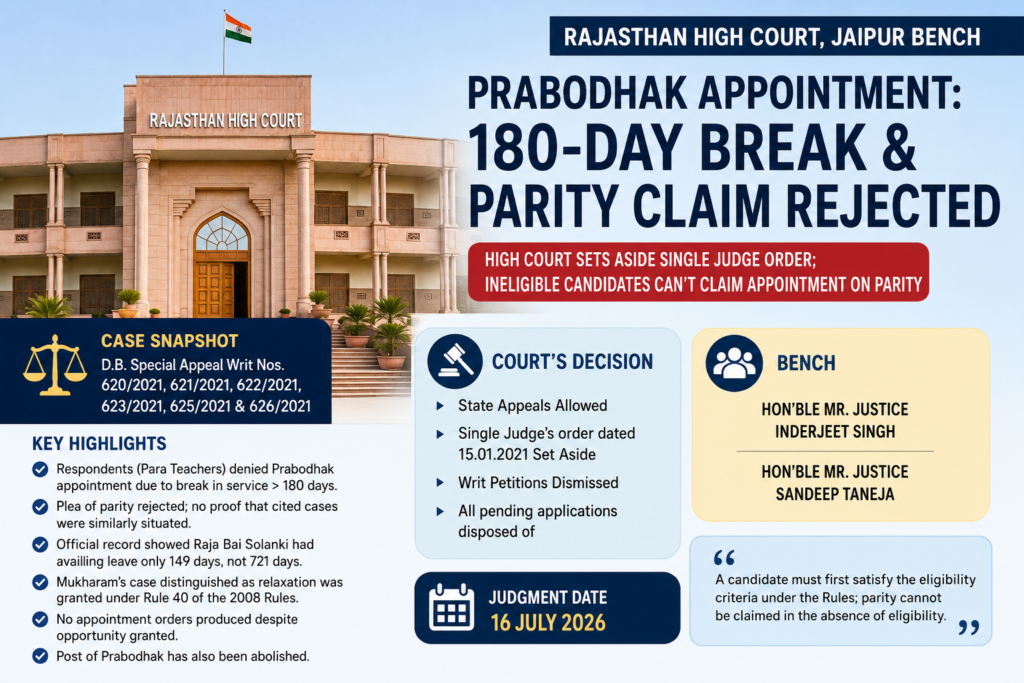
In D.B. Special Appeal Writ Nos. 620/2021, 621/2021, 622/2021, 623/2021, 625/2021 and 626/2021, the Division Bench of the Rajasthan High Court examined the correctness of a common order dated 15 January 2021 passed by the learned Single Judge. The Single Judge had directed the authorities to consider and give appointment to the respondents as Prabodhak on a notional basis from the date similarly situated candidates were appointed.
The Division Bench comprising Hon’ble Mr. Justice Inderjeet Singh and Hon’ble Mr. Justice Sandeep Taneja pronounced the judgment on 16 July 2026. The appeals filed by the State authorities were allowed and the writ petitions filed by the respondents were dismissed.
Background of the Case
The respondents in these connected appeals were working as Para Teachers and had applied for appointment to the post of Prabodhak.
Their candidature was denied because they did not possess the requisite experience prescribed for appointment. The principal issue was that they had a break in service exceeding 180 days during the relevant five-year period.
The candidates approached the Rajasthan High Court seeking relief principally on the ground of parity. They relied upon certain other persons whom they claimed had allegedly received appointment despite having a similar break in service.
One of the persons relied upon by the respondents was Smt. Raja Bai Solanki. According to the respondents, she had also availed leave exceeding the permissible period but was nevertheless appointed as Prabodhak.
The State authorities disputed this contention and submitted that Raja Bai Solanki had actually availed leave for only 149 days, which was within the permissible 180-day limit. The State relied upon a letter dated 5 October 2009 issued by the Joint Director, Elementary Education.
What Was the Main Legal Issue?
The principal question before the Division Bench was whether candidates who did not satisfy the eligibility requirements under the Rajasthan Panchayati Raj Prabodhak Service Rules, 2008 could obtain appointment by claiming parity with other candidates who were allegedly appointed despite similar deficiencies.
The respondents essentially argued that if another candidate had been appointed despite exceeding the 180-day limit, they should also receive the same benefit.
The State, on the other hand, argued that the candidates were themselves ineligible under the applicable Rules and that the alleged examples relied upon by them did not establish that an ineligible person had actually been appointed without lawful relaxation of the eligibility requirement.
Rajasthan High Court’s Finding on the 180-Day Break in Service
The Division Bench noted that the appointment to the post of Prabodhak was governed by the Rajasthan Panchayati Raj Prabodhak Service Rules, 2008.
The Court recorded that the respondents did not possess the requisite qualifying experience because they had taken leave for a period exceeding 180 days during the relevant five-year period.
Therefore, the Court treated the eligibility requirement under the Rules as an important consideration rather than permitting the candidates to bypass the requirement merely through a claim of parity.
This is significant because a claim of equality cannot ordinarily be used to demand repetition of an allegedly irregular or ineligible appointment without establishing that the comparator was actually similarly situated and lawfully entitled to the benefit.
RTI Information Versus Official Record
An important aspect of the judgment concerned information obtained under the Right to Information Act, 2005.
The respondents relied upon RTI information suggesting that Smt. Raja Bai Solanki had remained on leave for 721 days. On that basis, they sought to demonstrate that another person had allegedly received appointment despite exceeding the 180-day limit.
However, the State relied upon an official letter dated 5 October 2009 issued by the Joint Director, Elementary Education, stating that Raja Bai Solanki had remained on leave for only 149 days.
The Division Bench noted that the official letter had been placed before the learned Single Judge through an additional affidavit and that the respondents had not filed a counter-affidavit disputing its contents.
Which document did the High Court prefer?
The Division Bench held that the communication issued by the competent authority would prevail over the RTI information in the circumstances of the case, particularly because there was no material on record rebutting the contents of the official communication.
Accordingly, the Court rejected the respondents’ reliance on the alleged figure of 721 days of leave.
This aspect of the judgment is particularly relevant in service matters where information obtained through RTI is sought to be relied upon against a specific official record.
The judgment, however, has to be understood on its own facts: the Court was dealing with a situation where a specific communication had been issued by the competent authority, had been placed on record, and its contents had not been effectively rebutted.
Rule 40 and the Importance of Relaxation
Another important issue was the case of Mukharam.
The State submitted that Mukharam had been appointed despite a break exceeding the prescribed period because the competent authority had specifically exercised its power of relaxation under Rule 40 of the Rajasthan Panchayati Raj Prabodhak Service Rules, 2008.
The Division Bench accepted the significance of this distinction.
The respondents had neither claimed that they had applied for relaxation before the competent authorities nor made such a prayer in their writ petitions before the learned Single Judge.
Consequently, the Court held that Mukharam’s case could not be treated as a comparable case for claiming parity because his appointment involved a specific relaxation granted by the competent authority under Rule 40.
Why is this finding important?
The judgment demonstrates that two candidates are not necessarily similarly situated merely because their factual circumstances appear similar at first glance.
If one candidate received a benefit pursuant to a specific statutory or regulatory relaxation, another candidate cannot automatically demand the same benefit without satisfying the conditions for such relaxation or seeking it through the appropriate procedure.
Can an Ineligible Candidate Claim Appointment on the Ground of Parity?
In this case, the Rajasthan High Court answered the issue against the respondents.
The Court found that the respondents did not fulfill the eligibility criteria prescribed under the Rules of 2008. The Division Bench also noted that the learned Single Judge had not adequately dealt with the specific defence raised by the State concerning the respondents’ eligibility.
The judgment therefore reinforces an important principle in service jurisprudence:
A candidate must first establish eligibility under the applicable recruitment rules before claiming appointment on the basis of parity with another candidate.
A claim that somebody else received an appointment does not, by itself, establish a legal entitlement to appointment.
Failure to Produce Appointment Orders
The Division Bench also took note of an opportunity granted to the respondents on 30 May 2024 to place on record the appointment orders of persons who had allegedly been appointed as Prabodhak despite having taken leave exceeding 180 days.
The respondents failed to produce such appointment orders or other supporting documents establishing their allegation.
This was significant because the plea of parity was based substantially on the existence of similarly situated persons.
Without reliable documentary evidence establishing that the alleged comparator was actually appointed despite being similarly ineligible, the plea of parity could not succeed.
Rajasthan High Court’s Final Decision
After considering the eligibility requirements, the alleged instances of parity, the official record concerning Raja Bai Solanki and the relaxation granted in Mukharam’s case, the Division Bench concluded that the order of the learned Single Judge could not be sustained.
The Court held that the respondents were not entitled to appointment even apart from the subsequent issue concerning abolition of the post.
Accordingly, the Rajasthan High Court:
- Allowed the State’s appeals;
- Set aside the common order dated 15 January 2021 passed by the learned Single Judge;
- Dismissed the writ petitions filed by the respondents; and
- Disposed of all pending applications, if any.
Post of Prabodhak Had Also Been Abolished
The judgment contains an additional important observation.
During the hearing, the State brought to the Court’s notice that the post of Prabodhak had already been abolished. The State therefore submitted that the respondents could not, in any event, be granted appointment to the abolished post.
The Division Bench stated that, regardless of this subsequent development, the respondents were not entitled to appointment because they had failed to satisfy the eligibility requirements.
Thus, the Court’s decision was not based solely on the abolition of the post. The Court independently examined the respondents’ eligibility and the plea of parity.
Key Takeaways from the Rajasthan High Court Judgment
The judgment provides several important takeaways for candidates and practitioners dealing with service matters before the Rajasthan High Court.
1. Eligibility under recruitment rules is fundamental
Where appointment is governed by statutory service rules, a candidate must satisfy the eligibility requirements prescribed by those rules.
2. Parity is not automatic
A candidate cannot claim appointment merely by showing that another person allegedly received an appointment.
The candidate must establish that the other person was similarly situated and that the benefit was lawfully available in comparable circumstances.
3. Relaxation can make two cases legally different
Where another candidate received the benefit pursuant to a specific relaxation provision, that candidate may not be an appropriate comparator for a person who neither sought nor obtained such relaxation.
4. Documentary evidence matters
The Court specifically considered whether appointment orders or other documents were produced to establish the alleged instances of similarly situated appointments.
5. RTI information must be assessed in its factual context
The Court preferred the communication issued by the competent authority over the RTI information in the circumstances before it, particularly because the official communication had not been effectively rebutted.
6. Abolition of a post can independently affect the relief
Even where a dispute concerning eligibility continues, abolition of the concerned post may have a direct bearing on whether appointment can still be granted.
What Does This Judgment Mean for Prabodhak Candidates?
For former Para Teachers or other candidates seeking appointment as Prabodhak, the judgment highlights the importance of carefully examining the Rajasthan Panchayati Raj Prabodhak Service Rules, 2008, particularly the provisions concerning qualification, experience and relaxation.
A candidate who has a break in service exceeding the prescribed period cannot assume that an alleged appointment of another person automatically creates a right to appointment.
The factual and legal circumstances of the comparator must be established.
For example, if the other candidate received a specific relaxation from the competent authority under Rule 40, that fact may materially distinguish the two cases.
Frequently Asked Questions
What did the Rajasthan High Court decide in the Prabodhak appointment case?
The Rajasthan High Court Division Bench allowed the State’s appeals and set aside the Single Judge’s order directing consideration and appointment of the respondents as Prabodhak. The writ petitions filed by the respondents were consequently dismissed.
What was the issue regarding 180 days?
The respondents had taken leave exceeding 180 days during the relevant five-year period and consequently did not possess the qualifying experience required under the applicable Rules.
Could the candidates claim appointment based on parity?
The Division Bench rejected the parity argument because the alleged comparator cases were not established to be legally comparable. In particular, Mukharam’s appointment involved relaxation under Rule 40, whereas the respondents had not sought or obtained such relaxation.
What was the dispute regarding Raja Bai Solanki?
The respondents relied upon RTI information suggesting 721 days of leave, whereas the State relied upon an official communication from the Joint Director, Elementary Education, showing 149 days. The Court preferred the official communication in the circumstances of the case.
What happened to the writ petitions?
The Division Bench allowed the appeals, set aside the common order dated 15 January 2021 and dismissed the writ petitions filed by the respondents.
Which court delivered this judgment?
The judgment was delivered by the High Court of Judicature for Rajasthan, Bench at Jaipur, by a Division Bench comprising Justice Inderjeet Singh and Justice Sandeep Taneja on 16 July 2026.
Conclusion
The Rajasthan High Court’s judgment in the connected D.B. Special Appeal Writ matters concerning Prabodhak appointments is significant for its treatment of eligibility, parity, relaxation and documentary evidence.
The central lesson is that an appointment claim cannot be sustained merely by pointing to an alleged instance of another candidate receiving a similar benefit. The candidate seeking relief must demonstrate eligibility under the applicable rules and establish that the person relied upon as a comparator was genuinely and legally similarly situated.
The Court’s treatment of the 180-day service break, the official record concerning Raja Bai Solanki, the Rule 40 relaxation in Mukharam’s case and the failure to produce appointment orders were central to the decision.
The judgment was ultimately decided on the respondents’ lack of entitlement under the applicable Rules, while the Court also noted that the post of Prabodhak had already been abolished.
Case Details
Court: High Court of Judicature for Rajasthan, Bench at Jaipur
Case: D.B. Special Appeal Writ No. 620/2021 and connected matters
Connected Cases: D.B. Special Appeal Writ Nos. 621/2021, 622/2021, 623/2021, 625/2021 and 626/2021
Date of Judgment: 16 July 2026
Bench: Justice Inderjeet Singh and Justice Sandeep Taneja
Subject: Appointment to the post of Prabodhak; 180-day break in service; qualifying experience; parity; Rule 40 relaxation
Result: State appeals allowed; Single Judge’s order set aside; writ petitions dismissed.