
Dissolution of Hindu Marriage
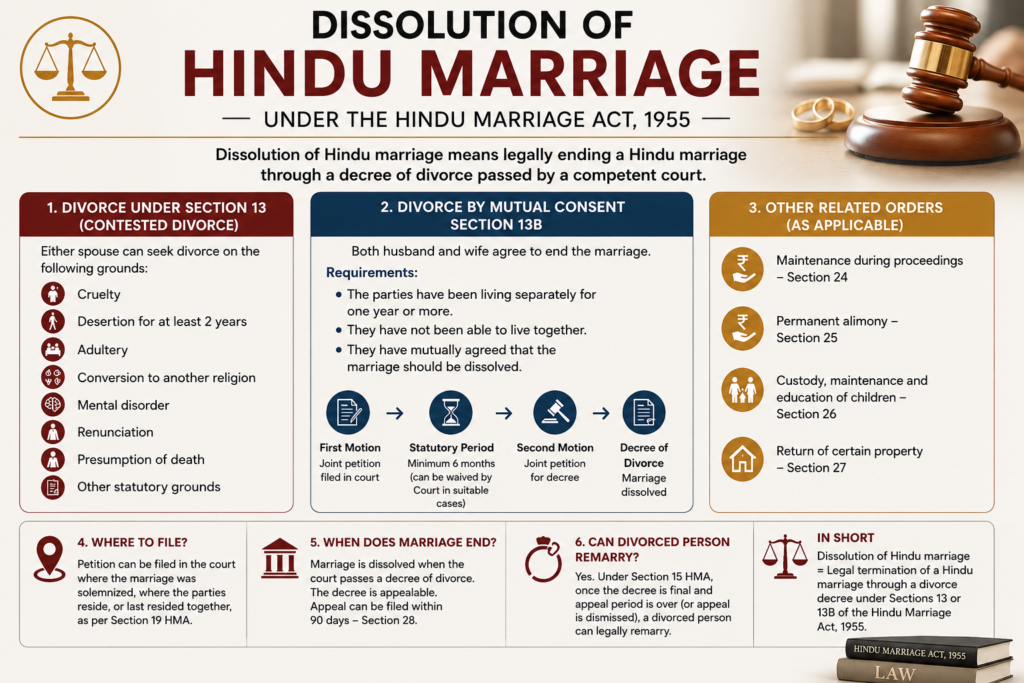
Dissolution of Hindu marriage means legally ending a Hindu marriage through a decree of divorce passed by a competent court. The principal law governing this is the Hindu Marriage Act, 1955 (HMA).The Hindu Marriage Act, 1955 (HMA) governs the laws of marriage and divorce for Hindus, Buddhists, Jains, and Sikhs in India. It replaced the traditional sacramental view of marriage with a legal framework that includes the right to divorce. The HMA offers two main types of divorce: Contested Divorce (under Section 13) and Divorce by Mutual Consent ( under Section 13B).
According to the Fault Theory, one of the two persons in a marriage commits some wrong, or is at fault somehow. The other person, the ‘innocent’ one can ask for divorce in this circumstance. Adultery, bigamy, or violence perpetrated by one can come under this theory. However fault theory is too binary. There is only black and white, no grey area. It claims that only one commits the fault and the other is the victim. This might not be the case at all times.
According to Mutual Consent Theory, the husband and wife mutually agree that the marriage is not working out and file for divorce. The Court may ask the parties to the marriage to live separately for a period of a year. If they still believe that their marriage can’t survive it is dissolved. In the case of Smt. Sureshta Devi vs Om Prakash, the conditions for divorce by mutual consent were discussed. The parties had to be living separately for a period of at least one year; it does not necessarily mean different houses. They may live in the same house, just not as husband and wife.
Judicial separation is a halfway ground between a functional marriage and its dissolution. A couple may decide, or a court may grant them, judicial separation instead of a divorce when it believes that the marriage might be saved in the future. It is not proper dissolution of the marriage, but a stepping stone to the remedy of divorce
Grounds for Divorce availed by both spouses
Section 13 of the Hindu Marriage Act, 1955 of divorce, a decree passed by court which announces absolute dissolution of a marriage. There are several grounds for divorce, some available to both husband and wife under Section 13(1), while some can only be availed by the wife under Section 13(2). These grounds are discussed below
- Adultery [Section 13(1)(i)]– it comes under the fault theory of divorce. It is considered a greatly important ground. Adultery is the consensual intercourse of a married person with another who is not his/her spouse. The aggrieved party or the victim may seek divorce on account of their spouse’s adultery. However there are certain essentials to adultery. The intercourse of a married person with someone other than their spouse has to be voluntary, that they must have done it on their own volition. The marriage has to be valid and subsisting at the time of the commission of the act. There has to be enough circumstantial evidence The aggrieved spouse can file a petition for divorce to dissolve the marriage. In Hirachand Srinivas Managaonkar v. Sunanda (2001), the Supreme Court of India stated that the husband’s continued adultery is an ongoing matrimonial offence and is not wiped out by a decree of judicial separation.
- Cruelty [Section 13(i)(ia)]– Cruelty can be either physical in the form of physical violence meted out to one party in the marriage by the other, or mental, in the form of unprecedented behaviour, insults in front of friends and family, mental pressure to undergo abortion etc. Signs of physical cruelty can be observed easily. However, mental cruelty is harder to prove in a court of law. In Samar Ghosh v. Jaya Ghosh (2007), the Supreme Court reversed the judgement of the High Court and restored the Trial Court’s decree of divorce which was granted based on mental cruelty5. This is a landmark precedent which made courts accept the mental aspect of cruelty.
- Desertion [Section 13(i)(ib)]– Without any reasonable cause, when one spouse, against the consent of the other, voluntarily leaves unexplained, and does not come back for a continuous period of two or more years, the spouse who is left behind may obtain divorce on the ground of desertion. It connotes one spouse renouncing the marital obligations and leaving permanently.
- Conversion [Section 13(ii)]– When a party to marriage converts to any other religion against the wishes of their spouse, under the Hindu Marriage Act, the aggrieved party can ask for divorce on the ground of conversion.
- Insanity [Section 13(iii)]– To appeal for divorce, under the ground of insanity, that is a spouse is of unsound mind, certain requirements need to be fulfilled. The unsoundness of mind of the respondent has to be incurable, and it has to be going on continuously or intermittently in such a way that the petitioner cannot be reasonably expected to live with them.
- Venereal Diseases [Section 13(v)]– A venereal disease like Chlamydia, HIV, Syphilis is sexually transmitted. It forms a ground for divorce of a person if their spouse has a venereal disease.
- Renunciation [Section 13(vi)]– Renunciation of the world is different from renunciation of marital duties that come under desertion. It is an old Hindu practice where a person renunciates the world and decides to walk on the path of god, as an ascetic. They are henceforth said to have no earthly attachments, marital or otherwise. Such a person is considered civilly dead. The spouse they leave behind can apply for divorce on this ground. However it is to be noted that it is different from desertion, where a person doesn’t give up all their earthly attachments, they only give up their marriage with the spouse.
- Presumption of death [Section 13(vii)]– If a person is missing for a period of seven or more years, in a way that neither his family nor friends have any word about him, that person may be presumed to be dead. In such circumstance, their spouse may apply for divorce.This principle has been strengthened by the precedent of Smt. Romila Chadha v. The State(Government of Delhi) (2023) in which a District Court of Delhi granted death certificate of the plaintiff’s father to her after her father had been missing for more than seven years6. This same principle is applicable in Hindu Marriage Act. If one of the spouses is missing for more than 7 years then the other spouse can seek divorce.
- Divorce by mutual consent- As per Section 13B, a petition can be filed for divorce by mutual consent of both the parties. The parties are required to wait for one year from date of marriage. They have to show that they are living separately for one or more year and not able to live with one another.
Grounds for divorce available only to wife
The Court and legislature, with the aim to protect and redress women’s grievances made certain grounds for divorce which are available only to the wife.
Husband’s Sexual Offences[Section 13(2)(ii)] :- This particular section states that if a husband has been found guilty of rape(sexual intercourse or assault without consent), sodomy(unnatural sexual acts) or bestiality(sexual activity between human and an animal) after the solemnization of the marriage, then the wife can seek divorce using this as a ground. In V. Ganesh v. Maya Sundari, although the Kerala High Court reversed the initial divorce decree passed by a Trial Court, it acknowledged the gravity of the sexual offense bestiality8. This particular provision is to protect dignity, bodily integrity and overall well-being of the wife ensuring that she is not looked down upon by society.
Divorce through maintenance decree[Section 13(2)(iii)] :- If a wife gets a maintenance order in her favor under Section 18 of The Hindu Adoptions and Maintenance Act, 1956 or Section 125 of CrPC, 1973 and continues to live apart for one year after that i.e. there is no co-habitation between them then she can ask for divorce.
Pre-Act Marriages and Bigamy[Section 13(2)(i)] :- Bigamy is prohibited under Section 10 of The Hindu Marriage Act. Section 13(2)(i) states that if a woman married a man before this Act came into force and that man was already married i.e. he has a living spouse, then she can challenge the validity of her marriage under this Act. This provision ensures that a woman is protected from being forced into a marriage that is legally invalid due to the husband’s prior existing marriage.
Right to annul underage marriage[Section 13(2)(iv)] :- This section states that the wife has the right to seek divorce if the marriage, whether consummated or not, was solemnized before she turned fifteen years and after attaining this age she has rejected the validity of the marriage. However, this needs to be done before she attains eighteen years of age.
Difference between Judicial Separation and Divorce
Though judicial separation can be sought based on the grounds for divorce, it is totally different from divorce. Judicial separation is a decree that allows the couple to live separately without dissolving the marriage i.e. they are still legally married and cannot marry anybody else. Marital duties and cohabitation gets suspended during this period. Court can end decree of judicial separation if reconciliation occurs and they start co habiting. Judicial separation is basically an alternative relief to divorce. The only similarity between judicial separation and divorce is that judicial separation can be sought based on the grounds available for divorce.
On the other hand, divorce is an ultimate decree that dissolves a marriage completely. The parties are free to remarry somebody else since their marriage is dissolved. Both the parties are discharged from their marital duties and responsibilities and they cannot reconcile unless they remarry each other.
By Advocate Shruti Goyal
Advocate in Jaipur