
Difference between Judicial Separation and Divorce
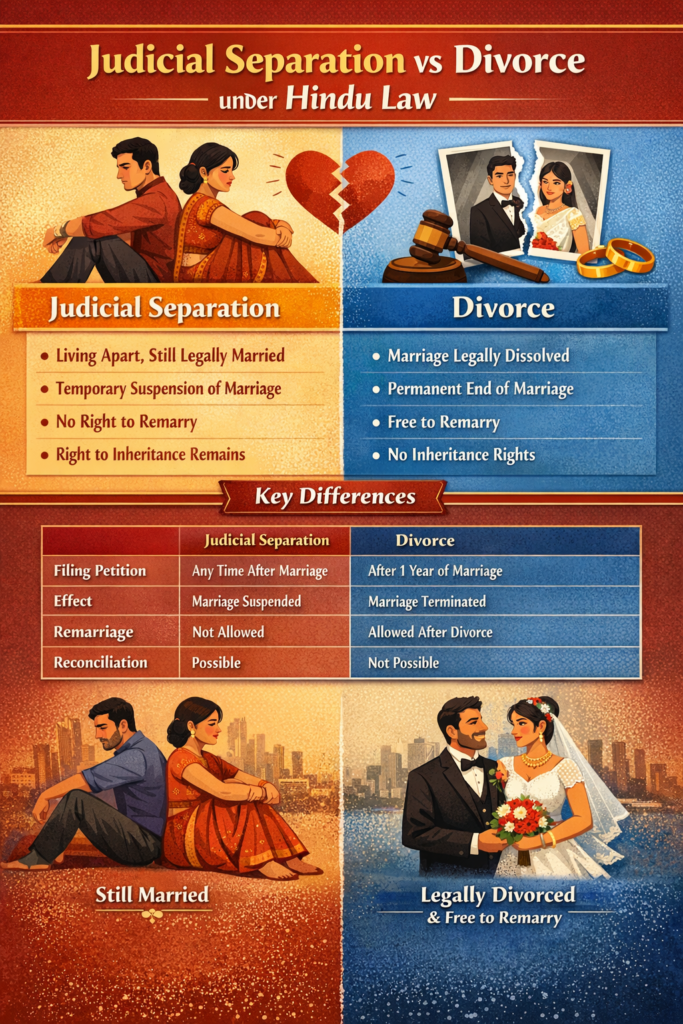
Marriage is considered as a sacrament under Hindu religion, representing an indissoluble bond between the husband and wife that is formed through sacred rituals and customs. The Hindu Marriage Act, 1955 provides the legal framework for obtaining judicial separation and divorce. Judicial separation is the suspension of marital duties and rights without dissolution of marriage, while divorce is the legal dissolution of the marriage.
Judicial Separation
It is a court order that allows husband and wife to live separately. The marriage still continues legally.
Divorce
It is the legal end of marriage. After divorce, both husband and wife are no longer legally married.
What is Judicial Separation and Divorce?
Judicial separation is a legal process that allows married couples to formally separate while remaining legally married. It offers an alternative to divorce and is often sought when couples want to live apart but do not wish to end their marriage entirely. It can be filed at any time after marriage and if the grounds are satisfied, a decree of judicial separation is granted.
This decree results in a temporary suspension of the marital relationship and the parties cannot remarry. Judicial separation may serve as a precursor to divorce in some jurisdictions and can provide an opportunity for reconciliation. The right to inheritance remains intact for both parties under judicial separation in family law.
Divorce is a legal process that ends a marriage entirely. It can only be filed after one year of marriage and the process involves a two-step judgment, with attempts at reconciliation before granting a divorce decree. Once a divorce is finalised, the marriage legally terminates and both parties are free to remarry. Divorce grounds typically include living in an adulterous relationship or meeting specific criteria as per the applicable legislation. The right to inheritance associated with the former spouse ends with divorce.
Under Section 10 of the Hindu Marriage Act, 1955, either party to a marriage, whether the marriage was solemnized before or after the commencement of the Act, has the legal right to file a petition for judicial separation. Once a decree in favour of the parties is granted, they are not legally obliged to live together or cohabit as a married couple. While they are permitted to live separately, some matrimonial rights and obligations still persist during this separation. It’s important to note that during the period of judicial separation, neither party can remarry.
Law in India
Under the Hindu Marriage Act:
Section 10 → Judicial Separation
Section 13 → Divorce
Marital Status
Judicial Separation → Husband and wife remain legally married.
Divorce → Marriage is completely dissolved.
Right to Remarry
Judicial Separation → Cannot remarry.
Divorce → Can remarry after decree becomes final.
Purpose
Judicial Separation is often taken as a “cooling-off period.”
It gives time to think and possibly reconcile.- Divorce is taken when parties want to permanently end the marriage.
Conjugal Rights
After judicial separation:
No obligation to live together.
If there is no resumption of cohabitation for 1 year after judicial separation, it can become a ground for divorce.
Maintenance & Custody
In both judicial separation and divorce:
Court can decide maintenance.
Court can decide child custody.
Court can pass orders for residence and expenses.
Judicial Separation and Divorce under Hindu Law
Divorce:- Divorce is a legal process where the marriage is dissolved, and both parties are no longer legally bound to each other. Section 13 of the Hindu Marriage Act, 1955 deals with the provisions of divorce. According to Section 13(1) of the Act, any marriage, whether solemnized before or after the commencement of this Act, may be dissolved by a decree of divorce upon presentation of a petition by either the husband or the wife on the following grounds:
- Adultery: If the other party has had voluntary sexual intercourse with any person other than his or her spouse after the solemnization of the marriage.
- Cruelty: If the other party has treated the petitioner with cruelty after the solemnization of the marriage.
- Desertion: If the other party has deserted the petitioner for a continuous period of not less than two years immediately preceding the presentation of the petition
- Conversion: If the other party has ceased to be a Hindu by conversion to another religion.
- Mental disorder: If the other party has been incurably of unsound mind or has been suffering continuously or intermittently from a mental disorder of such a kind and to such an extent that the petitioner cannot reasonably be expected to live with the respondent.
- Virulent and incurable leprosy: The spouse has been suffering from a virulent and incurable form of leprosy;
- Communicable venereal disease: The spouse has been suffering from a communicable form of venereal disease;
- Renunciation of the world: The spouse has renounced the world by entering any religious order;
- Presumption of death: The spouse has not been heard of as being alive for a period of seven years or more by those persons who would naturally have heard of it, had that party been alive.
Judicial Separation:-Judicial separation is a legal process where the court grants a decree of separation to the parties, which legally separates them but does not dissolve the marriage. Judicial Separation is defined under Section 10 of the Act.
“Judicial separation-
(1) Either party to a marriage, whether solemnized before or after the commencement of this Act, may present a petition praying for a decree for judicial separation on any of the grounds specified in sub-section (1) of section 13, and in the case of a wife also on any of the grounds specified in sub-section (2) thereof, as grounds on which a petition for divorce might have been presented.
(2) Where a decree for judicial separation has been passed, it shall no longer be obligatory for the petitioner to cohabit with the respondent, but the court may, on the application by petition of either party and on being satisfied of the truth of the statements made in such petition, rescind the decree if it considers it just and reasonable to do so.”
The key differences between judicial separation and divorce
| Aspect | Judicial Separation | Divorce |
| Time for Filing Petition | Any time after marriage | After one year of marriage |
| Stages of Granting a Decree | Single stage judgment | Two-step process (reconciliation, then divorce) |
| Effect | Temporary suspension of marriage | Termination of the marriage |
| Remarriage | Not allowed | Allowed after divorce decree |
| Ground for Divorce | One of the grounds for divorce | N/A |
| Basis for Granting the Decree | Single instance of adultery | Living in an adulterous relationship or specific grounds as per legislation |
| Reconciliation | Possible | Not possible |
| Right to Inheritance | Right to inheritance remains enforced | Ends once the divorce decree is granted |
A decree of judicial separation does not terminate the marital relationship but merely results in the legal suspension of conjugal rights, while a divorce decree conclusively dissolves the legal bond between the husband and wife, liberating them from their marital duties and obligations. Importantly, the court highlighted that a decree of judicial separation can be revoked by the same court that issued the decree, but a divorce decree can only be annulled through a judicial order, typically following an appeal or a review process.
– By Shruti Goyal
Advocate in Jaipur
