
Difference between Judicial Separation and Divorce
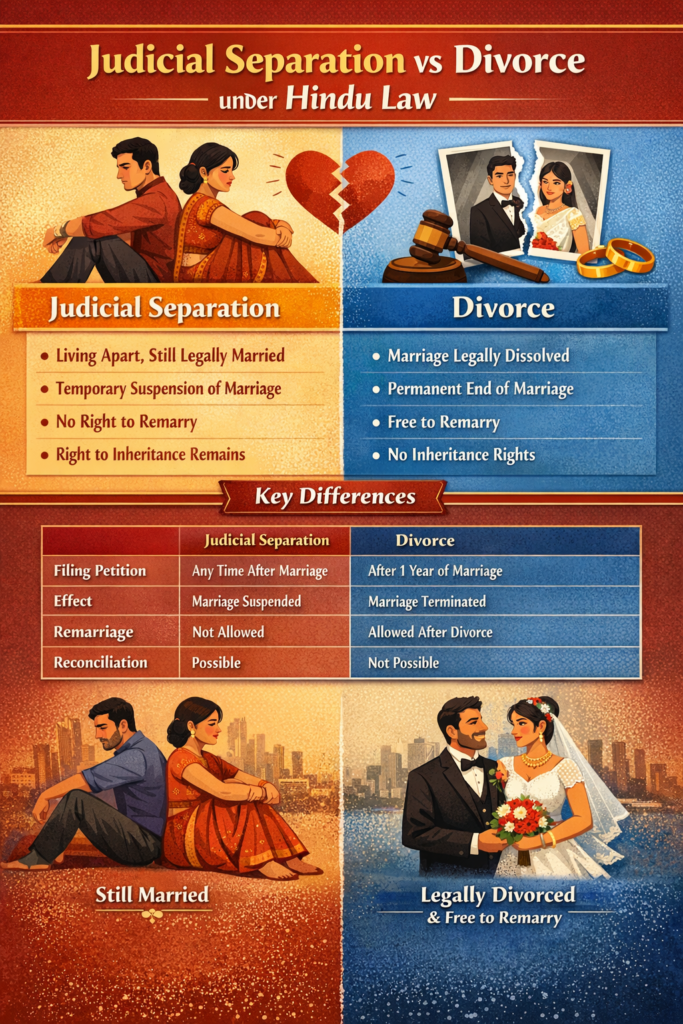
Difference between Judicial Separation and Divorce Marriage is considered as a sacrament under Hindu religion, representing an indissoluble bond between the husband and wife that is formed through sacred rituals and customs. The Hindu Marriage Act, 1955 provides the legal framework for obtaining judicial separation and divorce. Judicial separation is the suspension of marital duties […]
Article 21

Article 21 of the Indian Constitution protects the right to life and personal liberty. Article 21 is one of the most important fundamental rights guaranteed by the Constitution of India. It states: “No person shall be deprived of his life or personal liberty except according to procedure established by law.” “Protection of Life and Personal […]
BNS Section 103 – Bharatiya Nyaya Sanhita
The BNS’s Section 103 explains the punishments for murder. A person found guilty of murder faces life in prison or the death penalty as well as fine. Also, anyone who is part of a group of five or more people who commit murder together on the basis of a certain discrimination criteria like caste, sex […]
Doctrine of Repugnancy
The concept of Doctrine of Repugnancy is contained in Article 254 of the Constitution of India, 1950 (COI). Article 254 of the COI deals with the inconsistency between laws made by Parliament and laws made by the Legislatures of States. It states that – If any provision of a law made by the Legislature of a State is […]
Divorce by Mutual Consent

Under Hindu Law marriage is a sacrament and an eternal union. However, the grounds of divorce were introduced by the Hindu Marriage Act, 1955 (HMA). Divorce by mutual consent is one of the grounds of divorce that was introduced later by way of an amendment in the HMA. Divorce By Mutual Consent Divorce by mutual consent […]
Rights of Unpaid Seller

An unpaid seller is the one who has not received payment from the buyer for the goods or services they provided. In such a case, the seller has certain rights, such as the right to retain possession of the goods, stop their delivery, or resell them, depending on the circumstances and applicable laws. As per […]
Doctrine of Privity of Contract

Privity’ is the principle followed in contract law which states that terms of a contract are only binding upon the parties to a contract. They therefore cannot be enforced by a third party. This means that only parties to the contract can sue or be sued under it. This principle emanates from the English law. Privity of contract is one of the most fundamental tenets of the contract law. It prevents vesting […]
Doctrine of Eclipse
The Judiciary is the guardian of the rights provided for in the Constitution of India. It is the job of the judiciary to restrain the actions of the Legislature and the Executive where they are infringing upon these rights. When the Constitution was adopted on January 26, 1950, with it came, the fundamental rights that are […]
Rule Against Perpetuity

The word ‘perpetuity’ means indefinite period. The rule against perpetuity, also known as the rule against remoteness of vesting, means that a property cannot be transferred in such a manner that it becomes inalienable for an indefinite period. This disposition would be a transfer in perpetuity. Any disposition in perpetuity may arise in two ways: By […]
Lifting the Corporate Veil
In the landmark judgment of Saloman v Saloman Co. Ltd. (hereinafter refer as ‘Salomon case ‘), it was deduced that ‘company is a separate legal entity‘, having an identity of its own, which is independent and distinct form its members and shareholders. This is a well-settled principle recognized by many common as well as civil law countries around the […]