
Section 143A of Negotiable Instruments Act
Section 143A of the Negotiable Instruments Act, 1881 (NI Act) deals with the power of a court to order interim compensation up to 20% of the cheque amount in a cheque-bounce case under Section 138.
The Negotiable Instruments Act, 1881 can be defined as ‘an Act to define and amend the law relating to promissory notes, bill of exchange and cheques.’ The Negotiable Instruments (Amendment) Bill was presented before the Lok Sabha by the Finance Minister on January 2, 2018. It received the assent of the President and was notified in the Official Gazette on 2nd August, 2018 to become an Act called the Negotiable Instruments (Amendment) Act, 2018 (No. 20 of 2018).
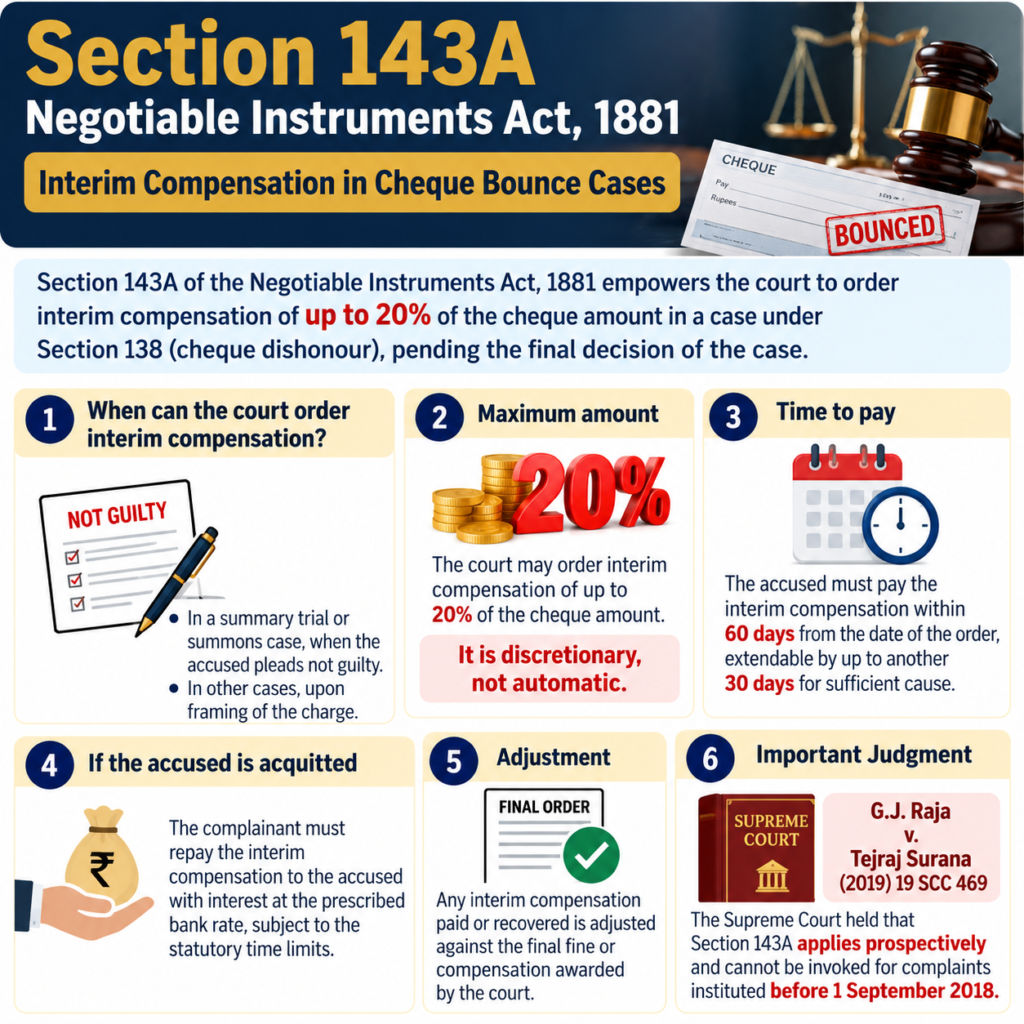
The Negotiable Instruments (Amendment) Act, 2018 introduces a new provision, Section 143A, to the Act of 1881. Section 143A of the Act provides –
“Notwithstanding anything contained in the Code of Criminal Procedure, 1973, the Court trying an offence under section 138 may order the drawer of the cheque to pay interim compensation to the complainant –
a) in a summary trial or a summons case, where he pleads not guilty to the accusation made in the complaint; and
b) in any other case, upon framing of charge.”
The amount of the interim compensation cannot exceed 20% of the value of the dishonored cheque.
The interim compensation described above must be paid within 60 days of the order requiring it or within such period not exceeding thirty days as maybe directed by the Court. Any compensation received can be deducted from the fine imposed by the Magistrate on the drawer’s conviction under Section 138 of the Act, or from any compensation ordered to be paid under Section 357 of the Code of Criminal Procedure of 1973. Section 138 of the Act provides for imprisonment of up to two years or a fine extending to twice the amount of the dishonored cheque, or both.
The interim compensation can be recovered using the procedures outlined in Section 421 of the Criminal Procedure Code, which allow for the attachment and sale of the drawer’s movable property or the issuance of a warrant to the Collector to recover the compensation from the drawer’s movable or immovable property as if it were unpaid land revenue.
If the drawer of the cheque is found not guilty, the court will order the complainant to pay back the interim compensation to the drawer, along with interest at the bank rate published by the Reserve Bank of India in the beginning of the relevant financial year within 60 days from the date of such order.
Section 143-A – Power to Direct Interim Compensation
When Court May Order: Court trying an offence under Section 138 can order the drawer to pay interim compensation to the complainant.
Timing of Order:
1.In summary trial/summons case: When drawer pleads not guilty.
2. In other cases: Upon framing of charges.
Compensation Limit: Interim compensation shall not exceed 20% of the cheque amount.
Payment Timeline:
1.Must be paid within 60 days of the order.
2.Court may extend by an additional 30 days on sufficient cause.
If Drawer is Acquitted:
1.Complainant must repay the interim compensation amount.
2.With interest at bank rate (as per RBI).
3.Within 60 days (extendable by 30 days on sufficient cause).
Recovery Method: Interim compensation can be recovered as if it were a fine under Section 421 of CrPC.
Adjustment:
1.Final fine under Section 138 OR.
2.Compensation under Section 357 CrPC.
3.Shall be reduced by the interim compensation amount already paid/recovered
What was the Background of Sri Madhu Ram Deka v. The State of Assam & Anr.(2026) Case?
Justice Pranjal Das of the Gauhati High Court in the case of Sri Madhu Ram Deka v. The State of Assam & Anr. (2026) set aside a trial court order directing payment of 20% of the cheque amount as interim compensation under Section 143-A of the Negotiable Instruments Act, 1881 observing that disputed questions requiring proper adjudication through evidence necessitate caution in granting interim relief.
The case arose from a criminal revision petition challenging a trial court’s order granting interim compensation under Section 143-A of the Negotiable Instruments Act, 1881.
The original complaint was filed under Section 138 of the NI Act relating to dishonour of a cheque for Rs. 20,00,000.
The cheque was dishonoured on the ground of “drawer’s signature differs”.
The trial court had directed the accused to pay 20% of the cheque amount as interim compensation to the complainant.
The petitioner/accused denied issuance of the cheque and disputed the signature on it.
The accused asserted that he did not maintain the account in question from which the cheque was allegedly issued.
The accused had lodged a complaint alleging forgery of his signature, leading to registration of a case under Sections 420/468/471 of the Indian Penal Code.
The petitioner’s submissions were supported by the testimony of the branch manager.
The respondent/complainant projected financial difficulties to support the claim for interim compensation.
What were the Court’s Observations?
The Court observed that “The court has to be satisfied about a prima facie case before granting interim compensation. The court to make such prima facie determination has to see the merits of the case put forth by the complainant and the merits of the defence put forth by the accused.”
The bench noted that “if the defence of the accused is prima facie found to be plausible, the court may exercise discretion in refusing interim compensation.”
The Court emphasized that there are disputed questions which will necessitate proper adjudication through evidence.
The Court held that only after proper adjudication through evidence would it be possible to answer the question as to whether the accused petitioner incurred criminal liability under Section 138 of the NI Act.
The Court concluded that “in such a situation… it may not be prudent to grant interim compensation at this stage, invoking the powers under section 143-A of NI Act. This is despite the projected financial difficulties of the respondent no. 2/complainant.
The Court accordingly set aside the trial court’s order directing payment of interim compensation.
By Advocate Shruti Goyal
Advocate in Jaipur