
Article 50 of the Indian Constitution
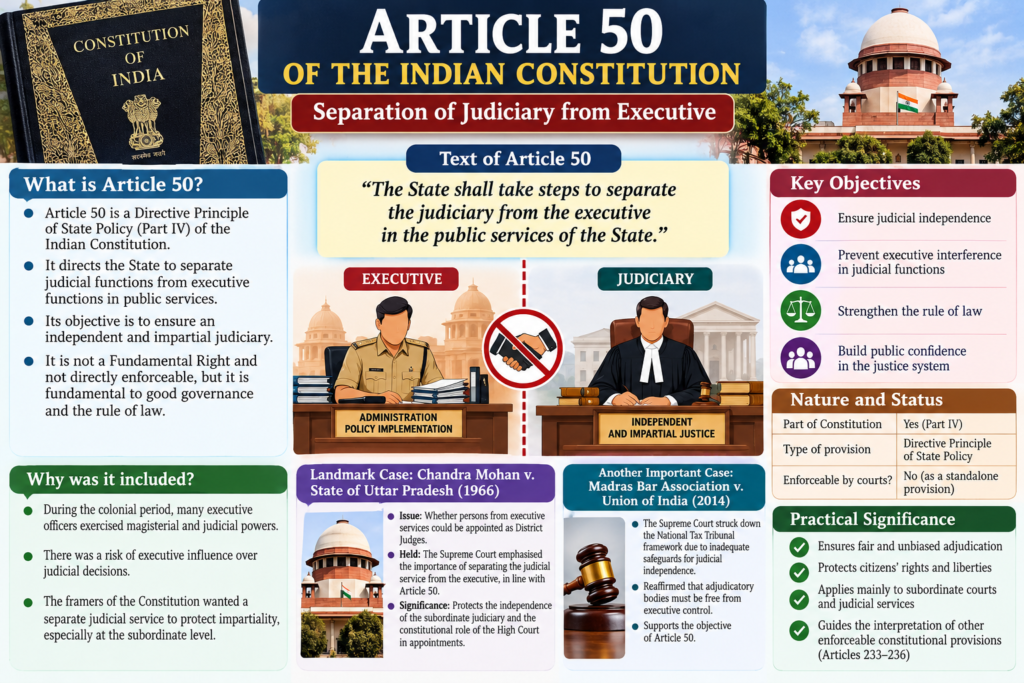
Article 50 of the Constitution of India is an important constitutional provision that seeks to ensure the separation of the judiciary from the executive. Its objective is to protect judicial independence, prevent executive interference in judicial functions, and strengthen the rule of law.
The Directive Principle of State Policy is described in Part IV of the Indian Constitution (DPSP). The Directive Principles of State Policy were inspired from the Irish Constitution. The Directive Principles of State Policy are regulations authored into the Indian Constitution that control the State. However, you cannot oblige the State to impose people in a Court of Law. Whereas the Fundamental Right is legally valid.
Article 50 of Indian Constitution plays an important role in safeguarding judicial independence. It affirms that judges must decide cases solely on the basis of law and evidence, free from external influence particularly from the executive branch. By reinforcing the principle of separation of powers, Article 50 ensures that:
Each branch of government functions within its defined sphere of authority.The balance of power among the branches is preserved
The provision is specifically concerned with the public services of the State, directing that judicial officers remain distinct from those serving in executive roles. This prevents overlaps that could undermine the impartiality and integrity of judicial decision-making.
After the East India Company was granted Diwani rights in 1765, it evolved from a trading organisation into a governing authority. Civil judicial functions were entrusted to Company Collectors, while criminal cases remained under Muslim officers applying Islamic law. By 1781, however, the Company began centralising criminal justice by granting magisterial powers to its own Collectors, consolidating executive and judicial authority in the same office.
Recognising the problem of overlapping functions between the judiciary and the executive, Dr. B.R. Ambedkar introduced Article 39-A (later renumbered as Article 50) in the Constituent Assembly on 24 November 1948. The provision sought to ensure the separation of the judiciary from the executive in the public services of the State, thereby safeguarding judicial independence.
The proposal was accepted the following day, 25 November 1948, with certain modifications, including the explicit insertion of the phrase “public services of the State” to broaden its application and ensure its relevance across all levels of governance.
Separation Of The Judiciary And The Executive- Article 50
Article 50 of the Indian Constitution explains the Separation of the Judicial system from the Executive. The judicial system is a separate entity. The judicial system is the constitution and bill of rights defenders. If the Executive commences operating like the judicial system, there will be a fight for power, so Article 50 differentiates the judicial system from the Executive. However, in certain cases, the Executive needs to perform judicial duties. They are assigned by the Executive, as is the instance of judges.
The definition of Separation of powers can be divided into three parts:
- A person who is a part of one organ should not be a part of another.
- One body should not obstruct the operation of the others.
- One body should not perform the role of another organ.
The notion of trias politica underpins the theory of power separation. This principle portrays a tripartite system in which capabilities are assigned and dispersed among three organs, each with its own regulatory authority.
The independence of the Judiciary is a necessary feature of the Rule of Law, which would be a fundamental characteristic of the Indian Constitution. The judicial system has to be independent of the executive compression and other pressure and expectations. However, the principle of democratic accountability must be restricted to the outer edges of the Indian Constitution and therefore can broaden further than that. The scope of judicial independence is wider in scope, trying to imply freedom from any stress or prejudice.
Key elements of Article 50
1. Constitutional objective: Separation of judicial functions from executive functions.
2. Primary purpose: Judicial independence and impartial justice.
3. Constitutional location: Part IV, Directive Principles of State Policy.
4. Nature: A constitutional directive to the State.
5. Practical significance: Preventing executive influence over the administration of justice.
Article 50 does not mean that the judiciary and executive cannot interact at all. It means that judicial decision-making must be protected from improper executive control.
Consequences Of Separation Of The Judiciary And The Executive- Article 50
The fundamental rule has two consequences. The first is that a Judge or Magistrate who gets to hear a specific instance cannot be linked to or take an interest in the court proceedings. Second, he should not be officially dependent on anyone implicated in the court proceedings for the defense involved.
It is inconceivable for a Judge to take an impartial perspective of the particular instance; he will attempt to do this if he is fully accountable for the achievement with one side or another. This is the very first point to recognize.
Article 50 of the Indian Constitution, as enshrined in the shape of Directly Principles in Part IV, requires the State to differentiate the Judicial branch from the Executive inside the State’s government services. According to one explanation, Article 50 of the Indian Constitution states for the detachment of the Judicial system overall from the Executive. However, a comprehensive review of the legislative record of Article 50 of the Indian Constitution uncovers that the main objective of Article 50 of the Indian Constitution was always the Separation of the Junior Judiciary from the Executive.
Article 50 is an essential provision for understanding judicial independence under the Indian Constitution. It directs the State to separate the judiciary from the executive in public services and reflects the constitutional commitment to impartial justice.
Its importance extends beyond the wording of the provision. Articles 233–236 and landmark decisions such as Chandra Mohan v. State of Uttar Pradesh,
The central principle is straightforward: justice must be administered by independent judicial authorities, not determined by executive preference.
By Advocate Shruti Goyal
Advocate in Jaipur